Airgentic for Higher Education
Everything they asked for. Nothing they didn't.
The conversational search and discovery platform for higher education. Prospective students find the program that actually fits. Partners and journalists find the right academic. Everyone finds what is genuinely on — because every question becomes a validated, fielded query against your real index, not a keyword guess.


Your website already has the answers. It just cannot turn a sentence into a search.
Every high-intent visitor arrives with a goal and a set of hard limits: not online, not that campus, shorter than a full degree, only during the holidays. Miss one of them and the answer is worse than useless — it is confidently wrong, and the student quietly leaves.
Put your own numbers on it: peak-month course-page traffic, your application conversion rate, and the fee value of one extra international enrolment. At that fee level a fraction of a percentage point is material — and it is leaking somewhere you cannot see.
Why this is a live decision, not a next year project
- Students have been trained to ask, not browse They arrive from AI answer engines expecting a conversation, and they judge you on the first question.
- Legacy search migrations are forcing the decision anyway Airgentic is more than a search upgrade. It has a measurable impact on business metrics.
Universities do not have one search problem. They have five.
Five distinct discovery problems, each owned by a different team, each with money attached.
Program finding
A vague goal drives semantic discovery; the firm constraints become exact fields. More qualified enquiries and stronger application conversion.
Expert finding
Industry partners, journalists and HDR applicants need a person, not a page — by research field, affiliation or method. Research income, media responsiveness, faster supervisor matching.
Event finding
Open days, campus tours, seminar series and offshore recruitment events, with the untidy real-world calendars they actually have. Higher attendance at the events that drive yield.
Site search
Hybrid semantic and keyword retrieval, scopes, facets, result cards and curated answers, with a Funnelback-compatible migration path. Fewer dead ends and less repeat contact.
Task-specialist agents
A small team rather than one assistant: Study Pathways Concierge, Enrolment Concierge, Student Support Navigator, Search Guide, plus human handoff. Guided progression instead of deflection.
Three questions that separate real discovery from autocomplete
Every vendor demos well on easy questions. These are the three that expose the difference. Bring them to your own evaluations and make each vendor type them live.
The negation problem
- The question"Can I do an MBA, but not online?"
- Most platformsRetrieve the passages that mention "MBA" and "online" and summarise them. There is no field for the negation to attach to, so it returns online MBAs — the exact opposite of what was asked.
- AirgenticConverts the negation into the delivery modes that actually exist in your catalogue, applies them as an exact filter, and tells the student which constraints were used.
The half-formed goal
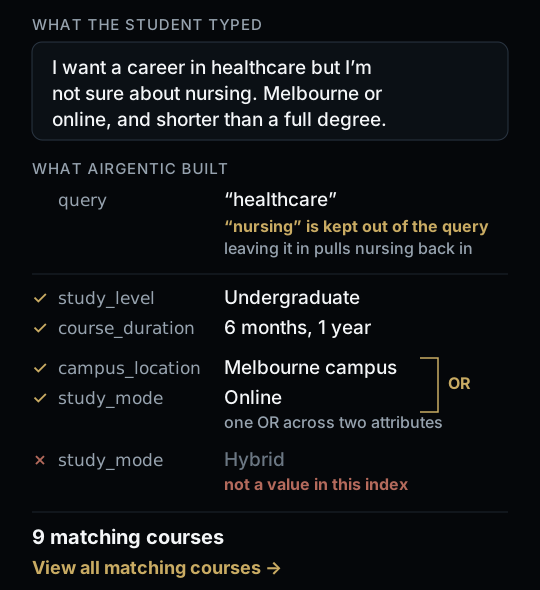
- The question"I want a career in healthcare but I'm not sure about nursing. Melbourne or online, and shorter than a full degree?"
- Most platformsFlatten the sentence into one bag of keywords. The "or" disappears, the duration is ignored, and "not nursing" still surfaces nursing — because the word is sitting in the query.
- AirgenticKeeps "healthcare" as the semantic goal and "nursing" deliberately out of it, then turns the rest into validated fields: Melbourne or online as one OR group, sub-degree levels and durations only.
The real calendar
- The question"What's on during the school holidays, and again in the last week of November?"
- Most platformsStore one date per page, so a six-week seminar series becomes one long event — and a single from-and-to box cannot express two separate windows anyway.
- AirgenticIndexes every occurrence with its own dates, including series that skip weeks, and matches as many separate time windows as the person asks about.
Then it shows its work, and lets them take it with them
Airgentic states which constraints it applied and links through to the same filtered results page a person would reach. Then comes the part that turns browsing into intent: "Save the three that fit and email them to me." No form, no friction, and you gain a self-qualified, permissioned, high-intent contact. Research partners and journalists do exactly the same with experts.
Precision is an architecture, not a prompt
Most AI search asks a language model to be careful. Airgentic does not rely on care. The agent never writes a URL or a keyword string — it emits a structured plan, and the platform validates every attribute and value against your live index before the search runs.
- Open intent goes to semantic search, constraints become exact fields A topic the student has ruled out is kept out of the query entirely, because leaving it in drags the results back to what they were avoiding.
- Values are checked against your index, not invented An unsupported value is dropped rather than guessed, so Airgentic cannot offer a campus you do not have or an intake that does not exist.
- One request produces the answer and the link The plan that returns the results also generates the "view all matching courses" navigation, so the page a student lands on matches what they were just told.
The guarantee: precision is enforced by the platform, not hoped for in a prompt.
It asks the questions your catalogue can actually answer
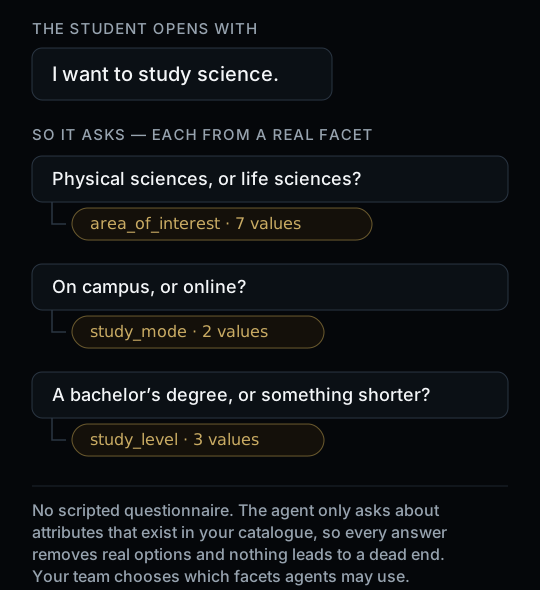
Real students do not arrive with four constraints ready. They type "I want to study science" and wait to be helped.
So the agent asks — and the questions are generated from the facets that exist in your index, using the values actually present in it. Not a scripted questionnaire, and not a guess about what you offer.
- Every question narrows something real It asks about study level because there are three indexed levels, not because a form has a study-level box.
- Your team decides what is askable You choose which facets agents may use, and the allowlist refreshes when the catalogue changes.
- When the list is still long, a Search Guide takes the turn It helps the student narrow further, instead of returning fifty results and hoping.

Your students tell you what they need every day. Now you can read it.
Every conversation is a stated intention, in the student's own words, at a known moment in the journey. It is the largest untapped voice-of-student dataset your institution owns, and nobody is reading it.
Airgentic clusters questions into themes automatically, then classifies them against taxonomies you define — by school, by enquiry type, by journey stage — each with a named owner.
What you find out
- Which programs and pathways are generating real demand, ahead of application data
- Where enrolment journeys break down, and in which week
- Which support topics current students cannot find, an early signal of disengagement
- Which themes are emerging that nobody planned for
Confidence scoring, review queues for borderline cases and a named owner per category mean it survives its first committee meeting.

Guidance that reflects where the student actually is
Airgentic tailors its agents by country — local entry-requirement context, market-relevant scholarships, in-country agents and events, and the study-mode restrictions that change what should be recommended — and answers in the student's own language.
Just as importantly, it does not assume. A visitor is treated as a prospective domestic student unless they raise overseas context, so institutions with strong domestic markets do not find every enquiry pushed down an international funnel.

Your team stays in control
Airgentic answers only from your approved content — pages, PDFs and connected sources — and your team decides what it can say, what it prioritises, and when it brings in a person.
- Scope and guardrails per agent, with curated answers you can pin or override
- Change messaging mid-enrolment-period or during a service disruption, without a release
- Restrict sensitive content to authenticated staff and students
- Role-based access, audit trails and configurable retention, with AU/NZ data residency options
And for the people who sign it off: one script tag, a Google Tag Manager container, or a plugin for WordPress, HubSpot, Storyblok or Datacom DataScape. Live in minutes rather than a three-month project, scoped to the URL patterns you choose, including behind a login.
Already delivering in higher education
British Columbia Institute of Technology (Canada)
BCIT partnered with Airgentic to deliver faster, more accurate AI-assisted service for students, staff, faculty and external stakeholders — round-the-clock support, multilingual assistance, stronger control over responses, and deeper visibility into what users actually need.
The core product works out of the box very well and you do not need to be a prompt engineer to get good responses. There are many ways to optimize performance, from curated responses to controlling which content is used for answers.
Ask every vendor to demonstrate these live
AI search demonstrations are easy to pass and hard to compare. Every item below can be performed in front of you, on your own content. We are confident enough in our answers to hand you the questions.
- Handle a negated constraint correctly — "an MBA, but not online".
- Handle an "or" across two different fields — "Melbourne or online" — without quietly turning it into an "and".
- Handle a numeric or duration range — "shorter than a full degree".
- State which filters were applied, and link to the same filtered results page a person would see.
- Demonstrate that the assistant cannot invent a campus, study level or delivery mode that does not exist in your data.
- Show that its clarifying questions come from your indexed facet values, not from a hand-written script.
- Search events with multiple non-consecutive occurrences, across two separate time windows in one question.
- Search people by research field, affiliation and method, conversationally.
- Let a user shortlist results and email the shortlist to themselves.
- Show both automatically discovered themes and governed, owner-assigned categories from real conversations.
- Change or override a specific answer, and update messaging mid-enrolment-period, without a software release.
Bring your hardest questions. We will type them live.
Most demonstrations are built around the questions a platform can answer. We would rather you brought the ones your prospective students actually ask — the ones with a "not" in them, two locations, a duration limit and two separate date ranges.
No obligation and no procurement process — just a working session with your real questions.
Still have questions?
Ask our AI — get cited answers about precision discovery, program finding, expert search and conversational intelligence for universities.