Airgentic for Local Government
Answer your community properly. Then read what they asked.
The conversational search and discovery platform for councils. Residents get accurate, cited answers from your own content at 10pm on a Sunday, in their own language. Your team gets a continuous, unprompted record of what the community actually needs.


Residents are already asking AI about your services. It is already answering.
Ask an AI assistant which day your bin goes out, or whether a front fence needs approval, and it will answer with total confidence — from a page you retired two years ago, an aggregator, or the neighbouring council. Your council carries the consequence, and nobody in the organisation can see it happening.
Put your own numbers on the rest: monthly contact volumes, the share that are simply "when, where, how much" questions, and your cost per contact by channel. This is not a headcount argument — councils do not cut frontline staff. It is a satisfaction argument, and satisfaction is measured, published and politically consequential.
Why this is a live decision, not a next-term project
- Residents arrive expecting to ask, not to navigate The A to Z service list is a 2010 interaction model, and it is the first thing a resident gives up on.
- A CMS replatform no longer has to gate this We deploy with a script tag, a Tag Manager container, or an integration for Squiz Matrix, Datacom Datascape or WordPress — beside your web project, not behind it.
“Airgentic has helped us deepen the connection between our community and the services they rely on. The assistant is already improving how residents access information—quickly, accurately, and in their own time. For a region as vast and unique as the Flinders Ranges, this technology is helping us bring people closer to their council than ever before.”
Councils do not have one search problem. They have five.
Five distinct discovery problems, each with a service outcome attached.
Service answers and how-to
Rates, waste, animals, parking and permits, answered from your official pages and PDFs with citations — not a link to the A to Z list. Fewer repeat contacts, and fewer residents acting on wrong information.
Places and facilities
Halls, ovals, libraries and playgrounds, searchable by capacity, day, features and accessibility. Better use of facilities you already maintain, and a straight answer for residents with access needs.
What is on
Library programs, markets, school holiday activities and seasonal events — including the recurring series and skipped weeks real council calendars are full of. Higher participation in programs you have funded.
Do it, not read about it
Agents look up a collection day for an address, walk a resident through a permit, or lodge a service request with location and context, inside the conversation.
Who to contact
Councillors by ward, departments by responsibility, and the right team for an issue. Fewer misdirected calls and forwarded emails.
Three questions that separate real answers from a search box
Every vendor demonstrates well on "what day is my bin collected". These three expose the difference, because council content is messier than almost anyone else's. Take them to your own evaluations and make each vendor type them live, on your content.
The four-constraint question
- The question"I need a hall for 80 people on a Sunday, with a kitchen and step-free access."
- Most platformsReturn the Venue Hire landing page and a PDF list of halls, leaving the resident to check four things by hand, one venue at a time.
- AirgenticReads capacity as a numeric range, the day as availability, and kitchen and step-free access as facility attributes — applies all four as hard filters, and tells the resident which ones it used.
The real calendar
- The question"What's on for kids during the school holidays, and again over the Easter long weekend?"
- Most platformsOffer a single from-and-to date box, and treat a weekly library program that skips a fortnight as one long event running for months.
- AirgenticIndexes every occurrence with its own dates, including series that skip weeks, and matches both time windows from the one question.
The cross-service task
- The question"I want to build a deck — what do I need from council?"
- Most platformsReturn the Planning landing page and stop, because the real answer is spread across planning, building, fees, forms and neighbour notification.
- AirgenticAssembles one answer from every relevant source, cites each of them, and links to the specific forms and fees that apply.
Then it does the thing the resident actually came to do
Airgentic states which constraints it applied and links through to the same filtered results a person would reach by hand. Then the conversation finishes the job: "Log it for me." A pothole, dumped rubbish, a missed collection — captured with location and context and routed to the right team. That is a completed transaction rather than a deflected call, which is a far better thing to be measured on.
Precision is an architecture, not a prompt
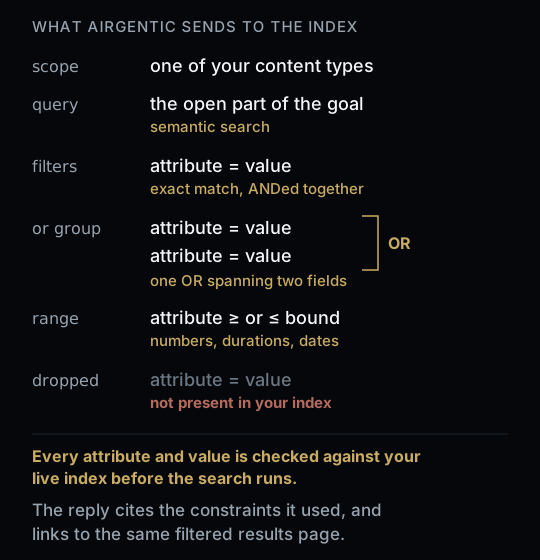
Most AI search asks a language model to be careful. Airgentic does not rely on care. The agent never writes a URL or a keyword string — it emits a structured plan, and the platform validates every attribute and value against your live index before the search runs.
- Capacity, days and features are real fields "Seats 80 or more" is a numeric range, "Sunday" is availability and "step-free access" is a facility attribute — not words to pattern-match.
- Values come from your data, not the model An unsupported value is dropped rather than guessed, so the assistant cannot invent a fee, a facility, a collection day or a permit you do not issue.
- Clarifying questions come from the same place Too broad a request earns a question about an attribute that actually exists in your index, so every answer narrows the list.
The guarantee: precision is enforced by the platform, not hoped for in a prompt.
Your community tells you what it needs every day. Now you can read it.
Annual satisfaction surveys are sampled and retrospective. Consultation portals are self-selecting, skewed towards the already engaged and the already aggrieved. Meanwhile every question typed into your website is unprompted consultation: continuous, in residents' own words, at the moment of need.
Airgentic clusters questions into themes automatically, then classifies them against categories you define — by service area, by ward or suburb, by intent such as report, apply, pay or find out — each with a named owner.
A worked example
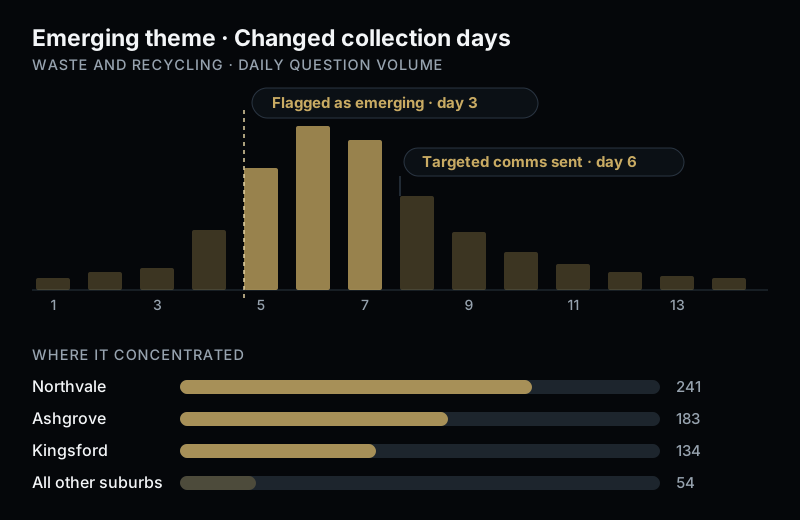
- A cluster forms around changed collection days after a waste route revision
- Volume concentrates in three suburbs within days, with clearly negative sentiment
- Targeted comms go to those suburbs, instead of the problem arriving as a spike in calls and a councillor's inbox
Over a quarter the same data becomes evidence for which service redesigns are worth funding. Confidence scoring, review queues, a named owner per category and drill-through to the conversations behind any number mean the report survives its first council meeting.

When it matters most, change the answer in minutes
Bushfire, flood and storm. An unplanned pool or depot closure. A waste route change, rates notices landing, the caretaker period. These are the moments when a stale answer becomes a real problem — and the moments when a website change request still takes three days.
- Pin, override or replace a specific answer, and publish emergency messaging, without a developer and without a release
- Point residents to the authoritative emergency source rather than letting an assistant improvise
- Narrow what agents may discuss during a live incident or a caretaker period
- Keep a record of what was published, when, and by whom
Outcome: your communications team controls the answer in minutes, in the channel residents are already using.

What procurement will ask, answered
Airgentic answers only from your approved content — pages, PDFs and connected sources — and cites the source of every answer. Grounding is the control that prevents misinformation, not a feature bullet.
- WCAG 2.1 AA conformant, so the assistant does not become an accessibility exception
- AU and NZ data residency options
- A Privacy and Retention Manager, so conversation data can be held and disposed of in line with your records obligations
- Role-based access, audit trails, and content scoped to authenticated users — including the same conversational search behind your staff login, for procedures, delegations and depot processes
And on deployment: one script tag, a Google Tag Manager container, or a purpose-built integration for Squiz Matrix, Datacom Datascape or WordPress, scoped to the URL patterns you choose. Live in days rather than a budget cycle, which matters when the digital team is two people.
Already delivering for local government
Hutt City Council (New Zealand)
A metropolitan New Zealand council. Hutt City launched Awa, an Airgentic agent on the Too Good to Waste website, where residents look up collection days for their own address and get accurate answers about what goes in which bin. Routine waste enquiries are resolved online, so customer service can concentrate on the conversations that need a person.
Ask every vendor to demonstrate these live
Every item below can be performed in front of you, on your own content. We are confident enough in our answers to hand you the questions.
- Handle four constraints in one facility question — capacity as a number, a day, a feature and an accessibility requirement.
- Show that its clarifying questions come from your indexed facet values, not from a hand-written script.
- Handle an "or" across two different fields without quietly turning it into an "and".
- State which filters were applied, and link to the same filtered results a resident would see.
- Demonstrate that the assistant cannot invent a fee, facility, collection day or permit that does not exist in your data.
- Search events with recurring and skipped occurrences, across two separate time windows in one question.
- Answer a cross-service task from multiple sources, with a citation for each.
- Lodge a service request, with location and context, from inside the conversation.
- Publish emergency messaging or override a specific answer in under five minutes, with no software release.
- Show both automatically discovered themes and governed categories mapped to service areas and wards, each with a named owner.
- Produce evidence on retention and disposal, audit trails, data residency and WCAG 2.1 AA conformance.
Bring your hardest questions. We will type them live.
Most demonstrations are built around the questions a platform can answer. We would rather you brought the ones your residents actually ask — the ones with a capacity, a day and an accessibility requirement, two separate date ranges, or four service areas tangled together.
No obligation and no procurement process — just a working session on your own content.
Still have questions?
Ask our AI — get cited answers about accurate resident answers, facility and event search, service requests and community intelligence for councils.